

The cursor blinks on a trading screen, illuminating the quiet pre-market hum. The ticker is ASTS, and it’s ticking up, just over 1%. It’s a small move, but it represents a much larger tension—a coiled spring of investor anticipation as AST SpaceMobile prepares to pull back the curtain on its third-quarter financials. The company, which promises to build the first space-based cellular broadband network, is a masterclass in narrative momentum. This anticipation is palpable, as reports show AST SpaceMobile (ASTS) Stock Holds Steady As Investors Await Q3 Results. But as any seasoned analyst knows, narratives don't pay the bills.
ASTS is what we call a "story stock." And right now, its story is a blockbuster. The company just announced a 10-year satellite connectivity deal with Saudi Arabia’s STC Group. It’s also partnering with Vodafone to build its primary European operations center in Germany, targeting a commercial launch in 2026. To top it off, it secured a $1 billion private offering of convertible notes (a form of debt that can convert to equity, potentially diluting existing shareholders) to fund its ambitious satellite constellation.
The market has responded exactly as you’d expect. The stock boasts a near-perfect Benzinga Edge Momentum score—97.65, to be exact. This metric essentially quantifies hype, and by that measure, ASTS is running white-hot. But I’ve looked at hundreds of these filings, and this particular setup, with its mix of retail excitement and institutional divergence, is where things get interesting. The story is powerful, but it’s colliding with a much colder reality.
A Tale of Two Analyses
For every investor captivated by the promise of global satellite connectivity, there's an analyst pointing to a balance sheet. The divide in professional opinion on ASTS isn't a crack; it's a chasm. On one side, you have B. Riley Securities, which in late October reiterated a Buy rating and raised its price target to a staggering $95. That’s the bull case in its purest form: a belief that the company will overcome every execution hurdle and capture a revolutionary market.
On the other side, you have a string of downgrades from some very serious names. Barclays, Scotiabank, and UBS have all shifted their positions to Underweight, Sector Underperform, and Neutral, respectively. These aren't minor adjustments. They are fundamental reassessments of risk from institutions that don't make such calls lightly.
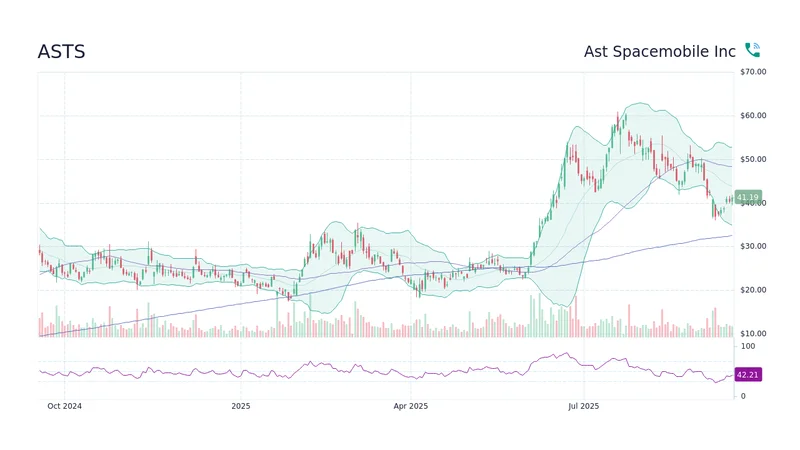
This divergence is the entire story. A stock's price is supposed to be a consensus on its future value, but here there is no consensus. It’s a tug-of-war between two opposing forces. The narrative acts like a powerful rocket engine, fueled by press releases and partnership announcements. But the analyst downgrades are like gravity, a constant, invisible pull reminding everyone that what goes up must eventually answer to financial reality. We don't have the specific reasoning behind the downgrades in the public filings, which leaves a critical information gap. What specific operational risks or cash-burn rates are the teams at Barclays and UBS modeling that B. Riley is not? Are they more skeptical about the 2026 commercial launch timeline, a date that feels both incredibly close and perilously far away?
The Moment of Truth Is a Number
Wall Street is expecting a loss of 22 cents per share on revenue of $18.93 million. In the grand scheme of a company valued in the billions, these numbers are almost symbolic. No one expects ASTS to be profitable today. The real test in this week’s report won't be the top-line revenue or the bottom-line loss. It will be the commentary on cash burn, capital expenditure projections, and any revision to the operational timeline.
This is where the narrative engine meets the unforgiving mechanics of engineering and finance. Building and launching a satellite constellation is one of the most capital-intensive, high-risk endeavors a company can undertake. The $1 billion in convertible notes sounds substantial, but in the world of space infrastructure, it can disappear frighteningly fast. Every delay, every technical setback, every launch failure costs not just time but a staggering amount of money.
The upcoming report is the market's first real data-driven check-in since the latest wave of hype began. The Vodafone and STC deals are fantastic validations of the concept. But they are not revenue. They are promises of future revenue, contingent on a flawless, multi-year execution of a plan that has never been successfully implemented at this scale before. The question is no longer "is the idea good?" The question is "can this specific team, with this specific amount of capital, actually build it before the money runs out?"
The Narrative Is Priced In. The Execution Isn't.
Let's be perfectly clear. The current stock price reflects a deep belief in the AST SpaceMobile story. The deals, the partnerships, and the vision of a connected planet are all baked into that $70.01 share price. What isn't priced in, and cannot be until it happens, is the brutal reality of execution. The downgrades from major banks aren't a dismissal of the dream; they are a statistical acknowledgment of the immense difficulty in achieving it. This week's earnings call is a single data point in a very long trajectory, but it will be the first to replace a bit of the story with a cold, hard number. And in the long run, the numbers always win.